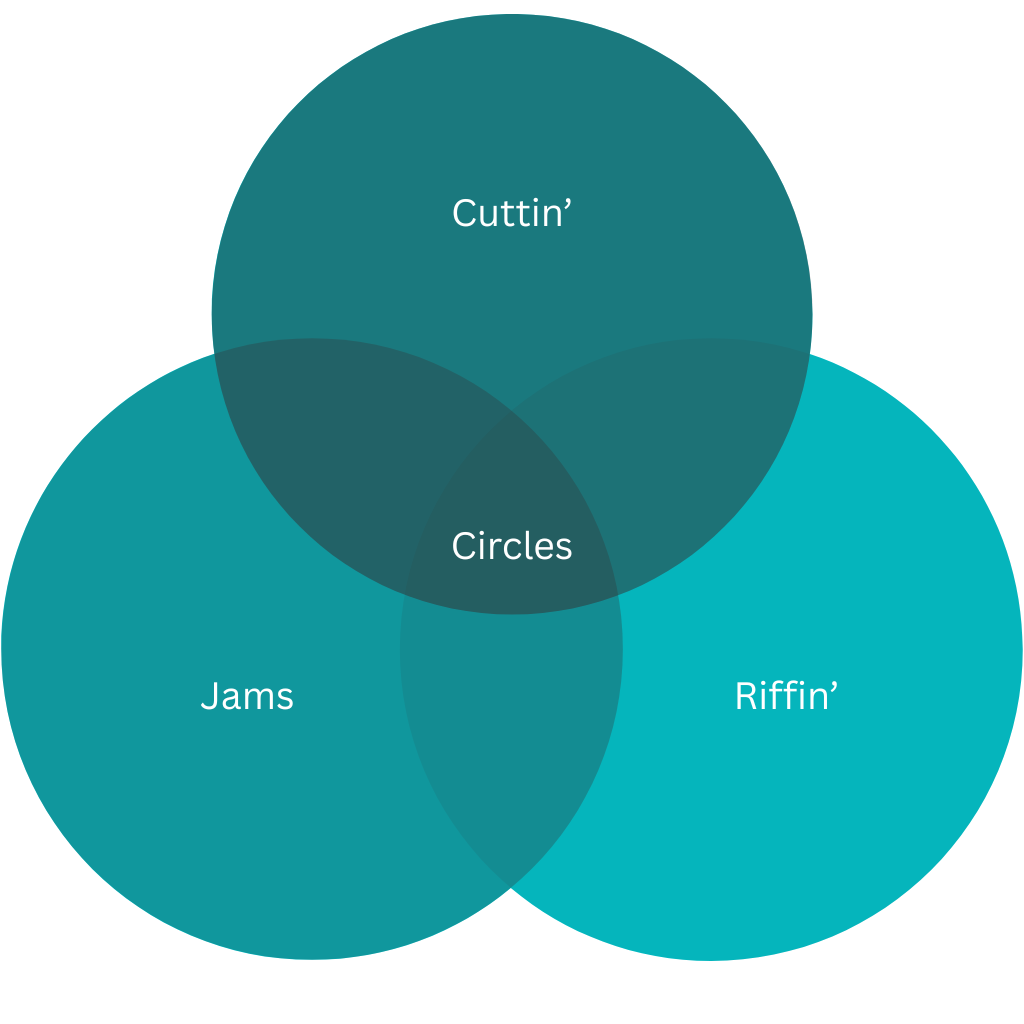
It’s the 90s. A small group of kids huddle together on a driveway. Double dutch and singing had finished. We’d play kickball earlier and there was some new music that had come out. Floating on the air from the radio. After insisting yet again, (to my rolled eyes) that Usher was IN FACT family, the group started dancing. Showing off. A small circle formed, clapping and jostling as we sang, screaming as people entered the circle to show off. My heart pounded, as my mouth dried.
These circles had a few different ways it could go, and none of them were my favorite. I tried to slink away but got dragged back into the group. My hands started sweating. I… HAD NOTHING. No ideas, no moves, and no confidence. I didn’t know these songs and wasn’t really a fan. I HATED this game and I was realizing that I was probably going to have to go in there. I’d been laughed out of even the gentlest circles before.
I stood, moving and clapping on autopilot (Checking in every so often because my claps tend to drift if I think too hard), watching and trying to figure out how screwed I was. Which circle was I about to step into, and was there signs of it building to the unluckiest, hardest circle of all… The one I prayed I wouldn’t see.
There was the easy circle. We all took a turn, stepping only a little bit into the circle and it passed quickly. It normally ended with us all dancing at the same time, screaming. You got cheers and hyped to do more, so we could reach that point before the song ended.
There was the harder circle. The center became a stage, with all eyes on you. The boldest went in, and showed off. A complicated mix of power, confidence, personality, age, and skill, determined who went in, for how long and who got to go again. This was a time of being more critical. If you wanted to be the center of attention, you’d best do something with it. Most importantly know how much time you should take up. A less good showing would get silence, or sympathetic encouragement from friends, it was best to get out quickly. If you were good though, you stayed and maybe even came back in a few rounds later. Kids cheered as the performer pushed themselves. Show off who you are and be celebrated for your growth.
Then… There was the one I hated. The other kinds of circles could turn into it with slight social shifts, or could be started from the start. The competitive one. Two people would enter the ring and someone had to lose. Some competitions leaned friendly but could easily be a fight between friends in the thin veil of dance. The friendly version had the feeling of “anything you can do, I can do better” but the more the tension between pairs increased, the more pent up energy caused things to feel like an argument on the edge of a fight.
Things seem to be turning competitive. Still I knew my time was coming and always hoped for an easy partner. Or that the song would end before my time. Until a hand on my back, shoved me forward. I stumbled into the circle and committed the worst sin…
I froze.
I had nothing to say. Nothing to say to my partner. Nothing to say about myself. Nothing to celebrate. Nothing to show of growth for. The group yelled for me to do something. Anything. Engage. The world closed in as I watched my partner threw it back in my face, my history of struggling and how they were clearly better than I, laughter echoing among the group. Until someone gentle tugged me back as I shook, with someone moving to replace me. Upset I backed out and away from the group. Knowing this would be something I’d be teased about mercilously in the coming weeks/months/years. Kida are cruel. I thought to myself about how I’d never dance again to avoid this humiliation in the future. It was better to be a a non dancer, than a dancer with nothing to say. An oddity is better than an embarrassment.
There was no name for these circles when I was growing up. I didn’t even think about them as that different. It was “just dancing”. It was only many years later, after I’d worked up the courage to try partner dance, then solo dance, to run into the circle again. To find out not only was this beyond my small group of friends but there was many ways we have engaged in dancing in circles as a culture. The one I was most surprised to see again? People called Cuttin’. I got part way through prelims at blues shout and had to leave in a panicked state.
I couldn’t stop thinking about my childhood experiences with cuttin’ I’d experienced, not realizing there were cultural lessons to be learned. But also only in childhood does someone cut like that, (without asking for a fight) unaware of the damage done. I ran off because I assumed I had or would embarrass myself all over again.
As I ran, I started to wonder. Where did we learn to do this? How do I know the rules but the white people didn’t. Why do they need “counts” isn’t it obvious? Why did I start to wonder if the kids from my childhood were being meaner than called for? What it means to be shy or sensitive in our culture? But most importantly, why was the fear of nothing having something to acknowledge my partner with (even in jest) and be passionate about myself was WORSE than being an outsider (a Black Non dancer).
a lesson in cuttin’
Years later a Black friend comes up to me at the dance. He’s frustrated and confused. “I still don’t get Cuttin’?!”
“What you mean?”
“I don’t get the point and how it is different than Riffin’. And WHAT is with this counting?! I don’t know if I am doing it right and I want to win.”
I laughed, gesturing him to the floor. “You know cuttin’.”
“I don-“
“You do.” I start moving. A pulse building to a two step. He matches me. I gesture for him to focus on me as I begin to walk a circle around him. “You just don’t know it by that name.” We orbit each other and continue matching. Establishing an easy rapport, and a back and forth. I suddenly stop.
Raising an eyebrow then looking him head to toe and back up again, crossed my arms and sat back. Pulsing. Waiting. Daring him. He makes eye contact, and his eyes glitter with understanding. “What chu got?” I ask silently. “Impress me.”
He starts dancing while I watch. He can do better. I keep my silent demand of “do better.” Written all over my body. Hearing the shift coming, I add energy into my pulse. Mimicking his movements small, in my own body. Bringing him into me. Until…
CLAP.
I took his last movement, and made it better. Showing him that I could not only do that too, but better than he was showing me, and then stacked my own styling on top until I out grew his idea and wanted to show him a bigger idea. Something harder. Something bigger and more nuance. I commanded his attention. Building a narrative raising the stakes higher. He pulsed and watched me cat like. The energy to “respond” building but I wasn’t done yet. The last beat I end on a movement. It’s hard but he can do better.
CLAP.
He springs into cuttin’ my opening. Elevating my idea and slowly winning my approval over his turn. But I won’t be making this easy for him. Intense eye contact and together we
CLAP.
We are getting closer together. The tension between us building. When he over steps by entering my space too much, I don’t retreat, I act as though his indiscretion is beneath me. Admonished he backs up.
CLAP.
We circle each other. He finds my weaknesses and I, his. I cover for mine “fair, I can’t do that but I don’t need to” I silently say. Cuttin’ him to ribbons. No. Do better. BAH! You think that’s good enough to impress me! When he bores me I look away. Feigning disinterest.
CLAP.
We are sweating. I am no longer cueing him and instead meeting him where he is slowly holding back less. He is a competitor, new or not, he needs to know, if he wants to win, what he is up against.
CLAP!
The song ends and we stare at each other. Both of us posing dramatically, we burst into room ringing laughter. Grabbing each other for hugs and congratulations! “Aye! That’s what I’m talking about!” He says.
“That’s cuttin’” I said chuckling “I told you, you already know how.”
“OooooooH! Why didn’t they just say that? We don’t need a class for that! And why make it so confusing with counts and stuff?”
“They DO need a class for that. It’s just that YOU don’t. Not that part at least. For them though the structure is helpful because I can’t do what we just did with you. They teach it that way so they can learn the unsaid rules.” He looks skeptical.
“Ight. Would you ever touch me in that?”
He looked horrified, “not unless I wanted to fight!”
“Ight. Why didn’t you dance when it was my turn? How did you know when to clap? Or even what the clap meant. Why did you know to tease me back?”
He considers. “I don’t know. It just seemed obvious.”
“That’s culture, not dance.”
what is cuttin’
These days I teach cuttin’ closer to how I taught my friend. It’s a nuanced but cultural way of doing it. It’s NOT the way I would suggest outsiders to teach it. (Or children frankly) Without additional cultural knowledge it is easy to learn the wrong lessons, to emotionally mare someone, or worse end up with a circle with no focus. That being said, what does someone do who isn’t from our culture to have a felt sense of these unsaid rules?
(If there is interest I can create a online lesson for teachers)
Learn to be an audience participant. Get comfortable with clapping on two and four for others, keep the circle JUST big enough that people can dance, maintain the pulse. An easy way to practice this is for jams, performances and if nothing else musicians. Let people know that you are with them, that you see them and all the effort it took to get there. The center is the call, and you are the response. Without you, we are alone. Be open to watching a pair of dancers, not far away but close up. You are their hype man. And that watching and cheering is what makes a circle naturally happen.
Most importantly, don’t let it die. I don’t care if you don’t have anything. If it’s been a little while and no one has gone in, to relieve someone or the center is empty, someone HAS to go. And that brave person better be celebrated hard. It is a gift they are giving.
If you are in the circle there is some fairly easy to say rules.
– No touching. Ever. if you do apologize profusely.
– Keep things a conversational distance. Too far and you lose connection, too close and things are PERSONAL.
– Take turns. Each turn takes up a certain musical distance. If you don’t know it or can’t tell, air on the edge of caution. And get out early.
– Make sure the person who you want to engage with knows that, with body language
– Keep your eye on your partner, if you take eyes off of them return them on their turn
– If they are a younger dancer, feel encouraged to find the balance between challenging and not making them lose face too much.
–
No matter if the circle is collaborative or competitive, the point is both to show yourself off and to encourage others to excel beyond what they might think was possible alone. The better you know your partner, the better you can cut them, or support them. What are they good at? What quirks do they have? Where do you have skill they don’t. What are you good at? What quirks do you have? What progress have you made and do you see theirs?
Join the circle to witness and be witnessed, celebrated and challenged.
Do you know cuttin’? Did you know about all these unspoken rules? Did I miss any? If you know this from other Black diaspora dances, what makes this similar and what makes it different?